
How far on one charge?

Real-world range and battery performance in extreme conditions
It's usually one of the first practical questions anyone asks before choosing a power wheelchair, and for good reason: running out of charge halfway through a trip isn't like running out of fuel in a car. There's no walking to the nearest station. For someone relying on the chair for genuine independence — a long rural driveway in Norway, a coastal walk in Australia's heat, a farm track in the English countryside — battery performance isn't a technical footnote. It's the difference between a chair that expands your world and one that quietly shrinks it.
The concern sharpens in extreme conditions. Cold weather and heavy terrain both drain batteries faster than a flat afternoon commute, and plenty of users have heard stories of batteries that perform beautifully in a showroom and disappoint the moment the temperature drops or the ground gets heavy.
Two gel batteries, not a single point of compromise
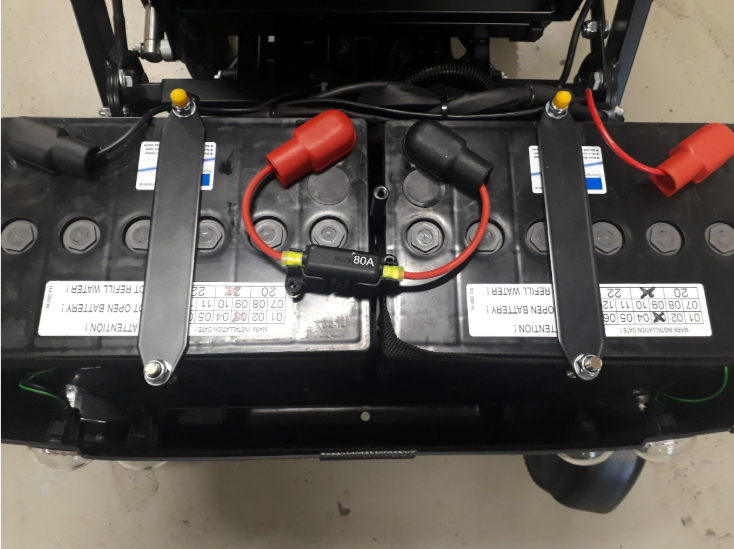
The FourX runs on two 12V (24V system) gel batteries, each rated at 70–74 Ah, delivering a range of roughly 35–41 km on a single charge. That range isn't a single fixed number by accident — it reflects the honest difference between covering flat gravel and grinding uphill through deep snow on the same charge.
Gel batteries were chosen deliberately over standard lead-acid cells. The electrolyte in a gel battery is suspended rather than liquid, which makes the battery maintenance-free — no topping up fluid, no checking acid levels — and reduces the risk of leakage if the chair tips significantly on rough terrain, which is a real consideration for a chair built to handle slopes and uneven ground.
Why cold doesn't hit gel batteries as hard
Low temperatures reduce the performance of every battery chemistry to some degree — that's basic chemistry, not a manufacturer-specific weakness. Lithium-ion batteries in particular often lose capacity more sharply in cold weather, and charging them below freezing is frequently restricted or discouraged depending on the specific cell chemistry. Gel batteries, by contrast, tend to hold their charge capacity more evenly across a wide temperature range, which matters directly in markets like Norway and the colder parts of the UK, where usable temperatures can swing from well above freezing to well below it within the same week.
That doesn't mean cold is irrelevant. Lower temperatures slow the chemical reactions inside any battery, so range genuinely shortens in winter compared with a mild summer day. The difference is manageable, not dramatic, and the chair remains fully usable in serious cold provided the batteries are stored and charged correctly — a topic covered in more depth in the article on warranty and service.
Heat at the other end of the scale
At the opposite extreme, Australian summer heat raises different questions. Gel batteries generally cope well with heat provided they aren't left charging in direct, prolonged high temperatures, and their stable energy density means performance doesn't collapse the way some battery types can when temperatures climb into the high thirties or forties. As with cold, the key variable is usually storage and charging discipline rather than the battery chemistry failing outright.
Four factors that determine real-world range
Four variables decide whether an actual trip lands near the top or bottom of that 35–41 km range.
Terrain softness. Snow and sand demand more torque from every motor than a firm, flat surface, because the wheels are doing more work just to keep the chair moving forward.
Inclines. A steep climb consumes energy at a multiple of flat-ground travel, since the motors are simultaneously fighting gravity and producing forward motion.
Combined user and load weight. A heavier total load means more work over the same distance — worth factoring in before attaching extra gear, such as fishing or hunting equipment.
Ambient temperature. As covered above, both extreme cold and extreme heat affect a battery's chemical performance, though gel batteries handle this more gracefully than many alternatives.
These four factors explain why a single number — "40 km" — never tells the whole story for any power wheelchair. A realistic estimate only comes from knowing your own typical route profile.
Why four-wheel drive doesn't simply multiply energy use
It would be reasonable to assume four motors draw more power than one or two. In practice it's more nuanced. When drive is split across four wheels, no single motor has to produce as much torque on its own, which evens out the overall load. Just as importantly, a four-wheel-drive chair is far less likely to get stuck spinning uselessly on soft ground — and a spinning, stuck motor burns energy without producing any forward progress at all. Efficient movement through difficult terrain is ultimately more energy-efficient than constant wheelspin that goes nowhere.
Putting the range into everyday context
35–41 km sounds abstract until you set it against real use. A typical outing — a walk, a fishing trip, an errand — rarely exceeds ten kilometres each way, which leaves a comfortable margin even when part of the route crosses demanding terrain. Daily errands are usually shorter still. Range is really tested on longer outings, or when the chair is used for both the outbound and return leg of a trip with no chance to charge in between — a full day out hunting or exploring, for example.
As a practical rule of thumb, expect real-world range to land toward the lower end of the scale in demanding winter terrain or on a steep climb, and toward the upper end on a flat summer gravel path. That's not a weakness — it's physics, and it would apply to any battery-powered device.
Charging as a daily habit
Charging gel batteries is straightforward and doesn't require special expertise. It's worth building into a routine — overnight, much like charging a phone — so the chair is always ready for the next outing without having to calculate remaining range before every trip. On longer outings with no charging point available, it helps to plan the toughest climb or softest terrain for the start of the route, while the battery is at full charge.
Battery lifespan and long-term care
Gel battery lifespan depends heavily on charging habits and storage temperature. Maintenance-free doesn't mean maintenance-ignored: battery condition should still be checked as part of routine servicing, and the chair should be stored in a warm, dry space whenever possible, since prolonged cold storage degrades capacity more permanently than short periods of cold-weather use. Range also isn't a fixed number across the chair's entire lifespan — it shifts slightly as the battery ages, exactly as it would with any battery-powered device.
What to ask about during a trial
When trialling the chair, it's worth asking the assessor or distributor to talk through range in terms of your own typical routes rather than an abstract maximum figure: how far is a normal outing, how much of it crosses difficult terrain, and how much incline is involved. That conversation, grounded in your own daily reality, tells you far more than the headline range figure ever will, and it's worth having before any funding application is finalised.
Why this matters differently across markets
Many international manufacturers design their battery systems primarily for milder climates, where cold-weather performance simply isn't tested or prioritised to the same degree. A gel battery system chosen specifically for demanding, variable climates is one of those details that doesn't always show up in a brochure but becomes obvious the first time a proper cold snap or a genuine heatwave arrives. Manufacturing and testing in Kuopio, Finland means the chair is developed in a climate that already spans both ends of that spectrum, rather than being adapted afterwards for export.


Comments